All Topics
Enlaye is the AI-native risk platform for general contractors — turning years of project documents into searchable, scenario-ready risk intelligence from bid through handover.
Enlaye



Enlaye is an AI-native risk lifecycle management platform that helps general contractors find, mitigate, manage, and control commercial, contractual, and financial risk across the entire project lifecycle — from RFP through construction to handover.
• Contractors operate on 3–5% margins where a single missed contractual clause — a liquidated damages cap, an indemnity exposure, an onerous milestone — can wipe out a project's profit
• Project knowledge is buried across thousands of pages of RFPs, contracts, specs, and procedures, plus whatever sits in SharePoint, Autodesk Construction Cloud, Procore, and on individual hard drives. (Per the Autodesk statistic Philippe cites: ~96% of construction data sits unused on drives)
• Risk analysis at bid time is manual and time-pressured — risk registers that take a five-person team three weeks to fill out, no-go matrices that get applied inconsistently, and scenario modelling that gets capped at five variations when fifty would be more useful
• Field-level risk closure happens via "go read the procedure and Ctrl-F" — junior engineers left to navigate documentation alone
• Connects to where the data already lives — no migration required.
• Builds a construction-specific data network across the project's documents.
• Exposes that network through three modes:
• A chat interface for discovery
• An automation layer for repeatable company-specific analyses
• A Guardian Angel mode that surfaces proactive recommendations on field issues
• The whole platform is grounded in source-of-truth links so users can verify how the AI got to any answer
• Pre-construction — estimating, bid, no-go decisions, contract review
• Construction — subcontract management, change orders, field issue closure
• Handover — assembling closeout packages from years of project history
Architecture and setup.
• Two-level structure: a company-level view across all projects, and a project-specific view for single-job work
• Octopus-style integration — connects to Autodesk Forma (formerly ACC), SharePoint, and other systems so files don't need to be migrated, with documents added directly into Enlaye also supported
• Builds a proprietary network across project data in a format purpose-built for construction and infrastructure projects
• Each customer sits on their own secure cloud; Enlaye does not train across customers, and customers within the same parent group are isolated from each other
Natural-language queries with agent orchestration that asks itself construction-relevant follow-up questions. The "LDs?" example: a senior user typing only "LDs?" still gets a structured answer covering the milestone-by-milestone breakdown, the most expensive milestone, and whether there's an overall cap.
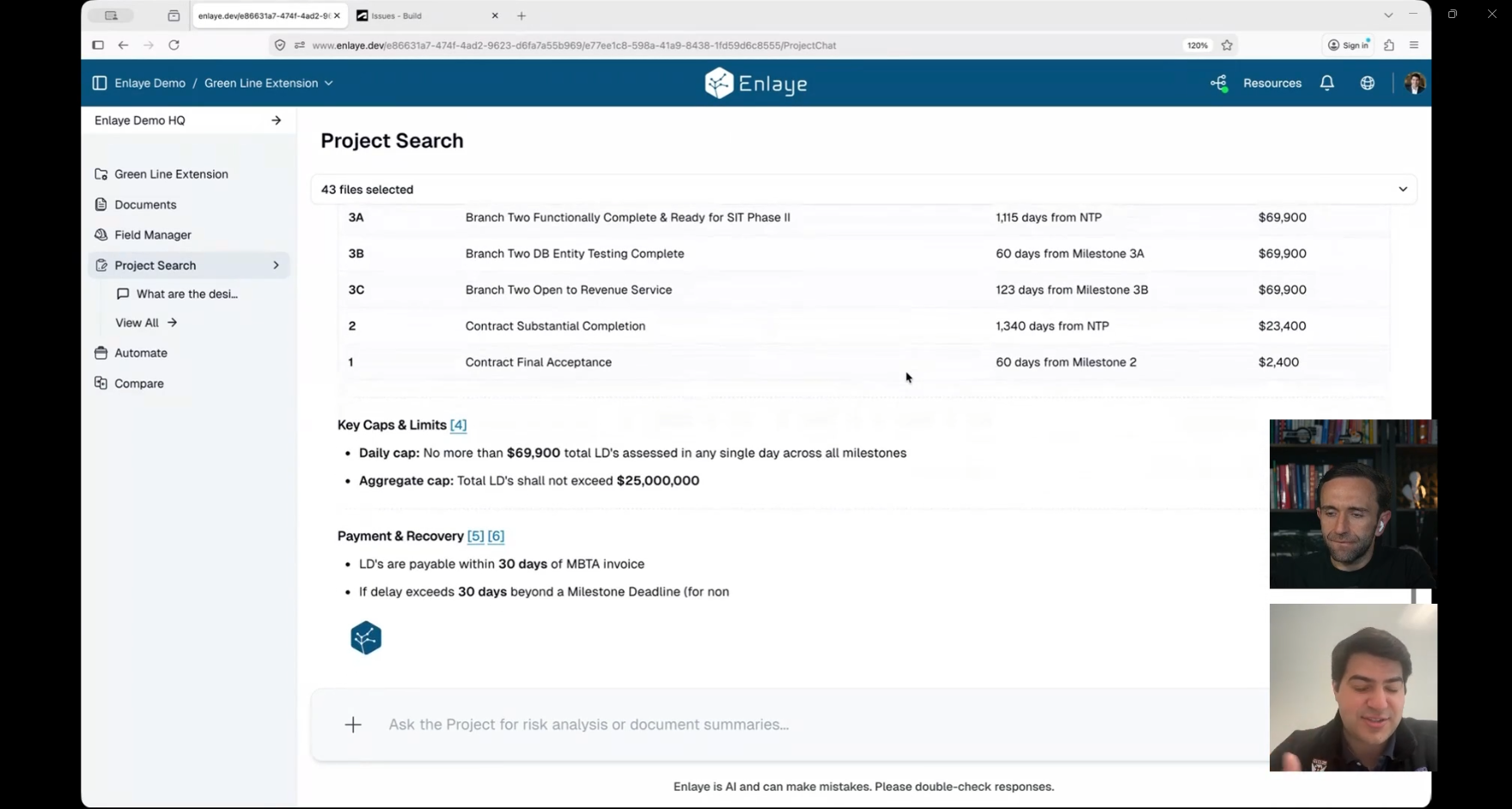
Every claim links back to the exact page in the originating document; users spend roughly 5x longer in the source panel than in the chat itself, which Enlaye treats as a feature, not a bug. Used vs unused sources are both shown.
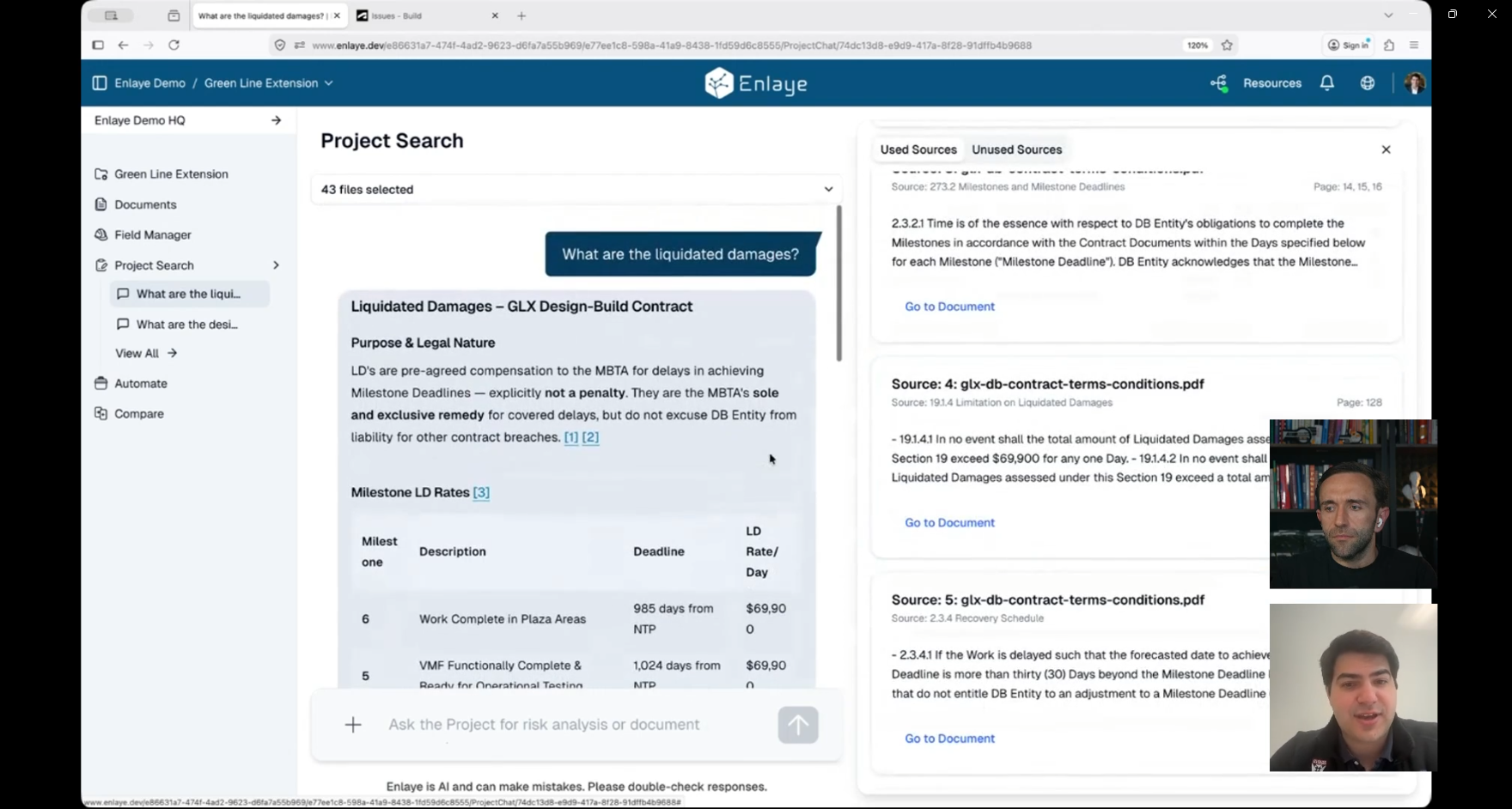
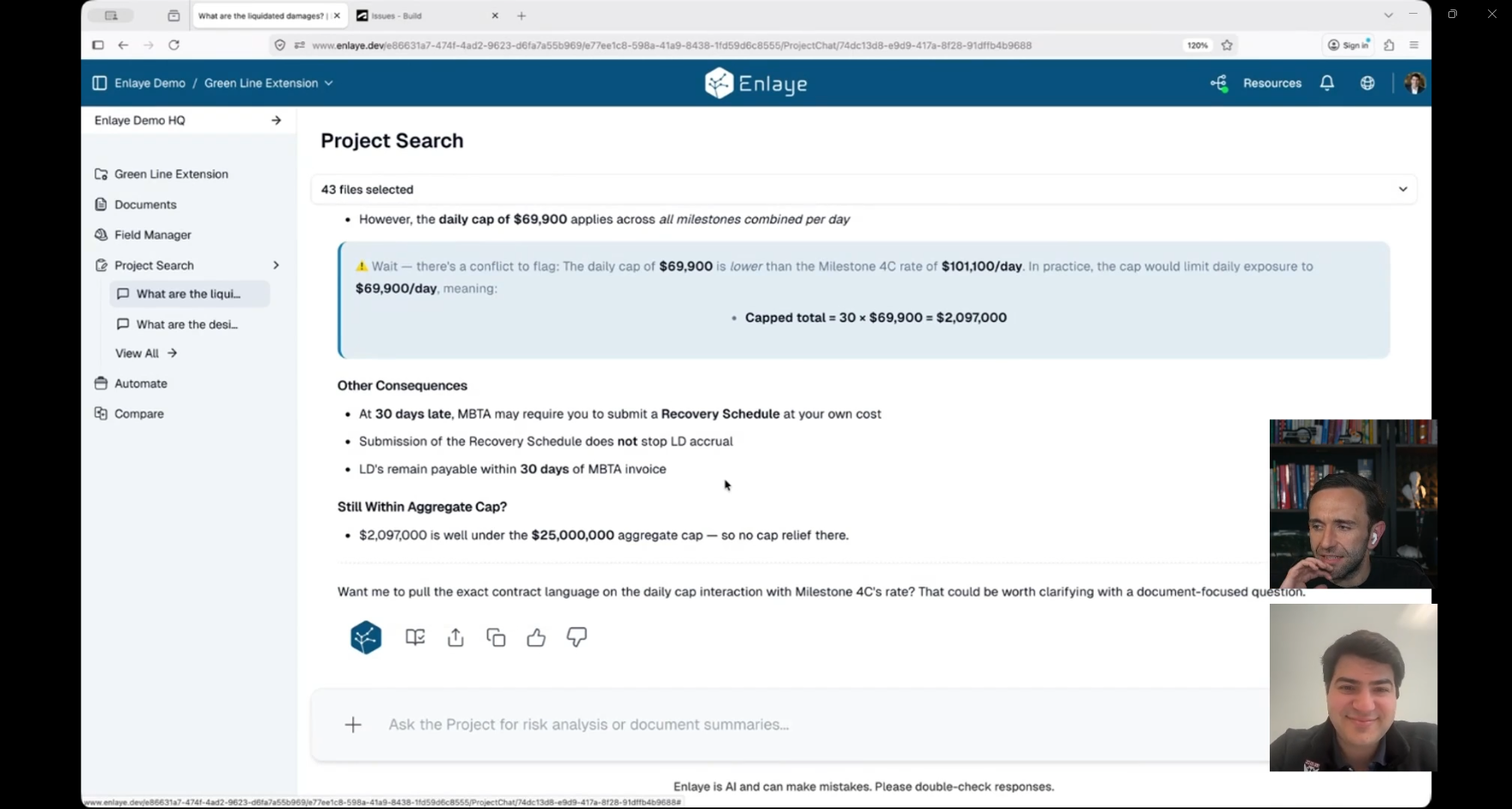
When the AI is reasoning rather than retrieving, it explicitly distinguishes the two and shows no sources for reasoning answers. The "what happens if I'm 30 days late on milestone 4C?" example demonstrated cap calculations and cascading critical-path effects.
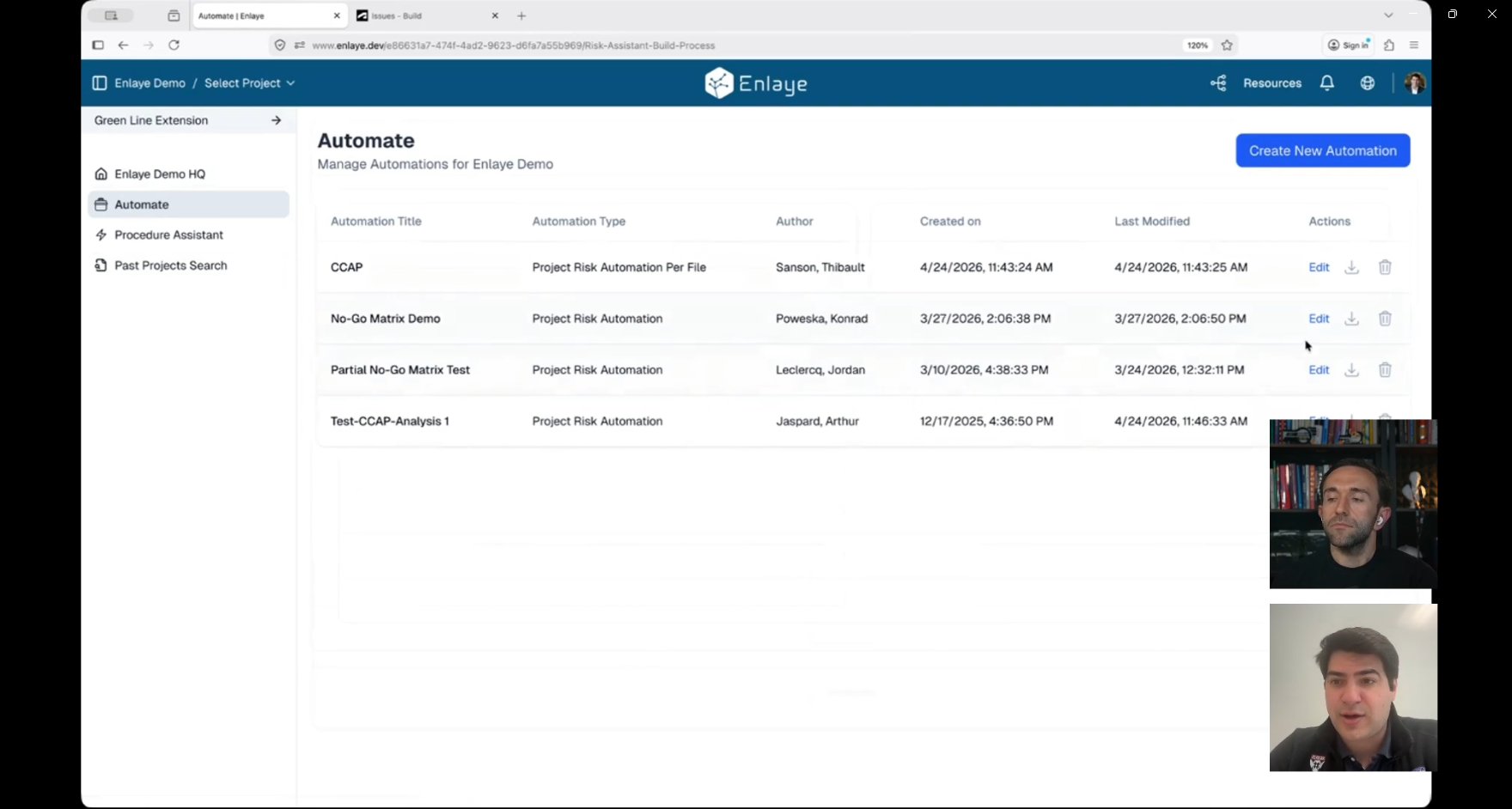
Company-level templates for repeatable workflows like no-go analysis. Each automation has a question column and a gap-analysis column that compares the project against the company's preferred position (e.g. "we want a 15% LD cap" — flags poor alignment if the contract specifies 35%). One European environmental compliance team has built 110+ automations for different topics; an automation can run across 20,000 pages in under two minutes.
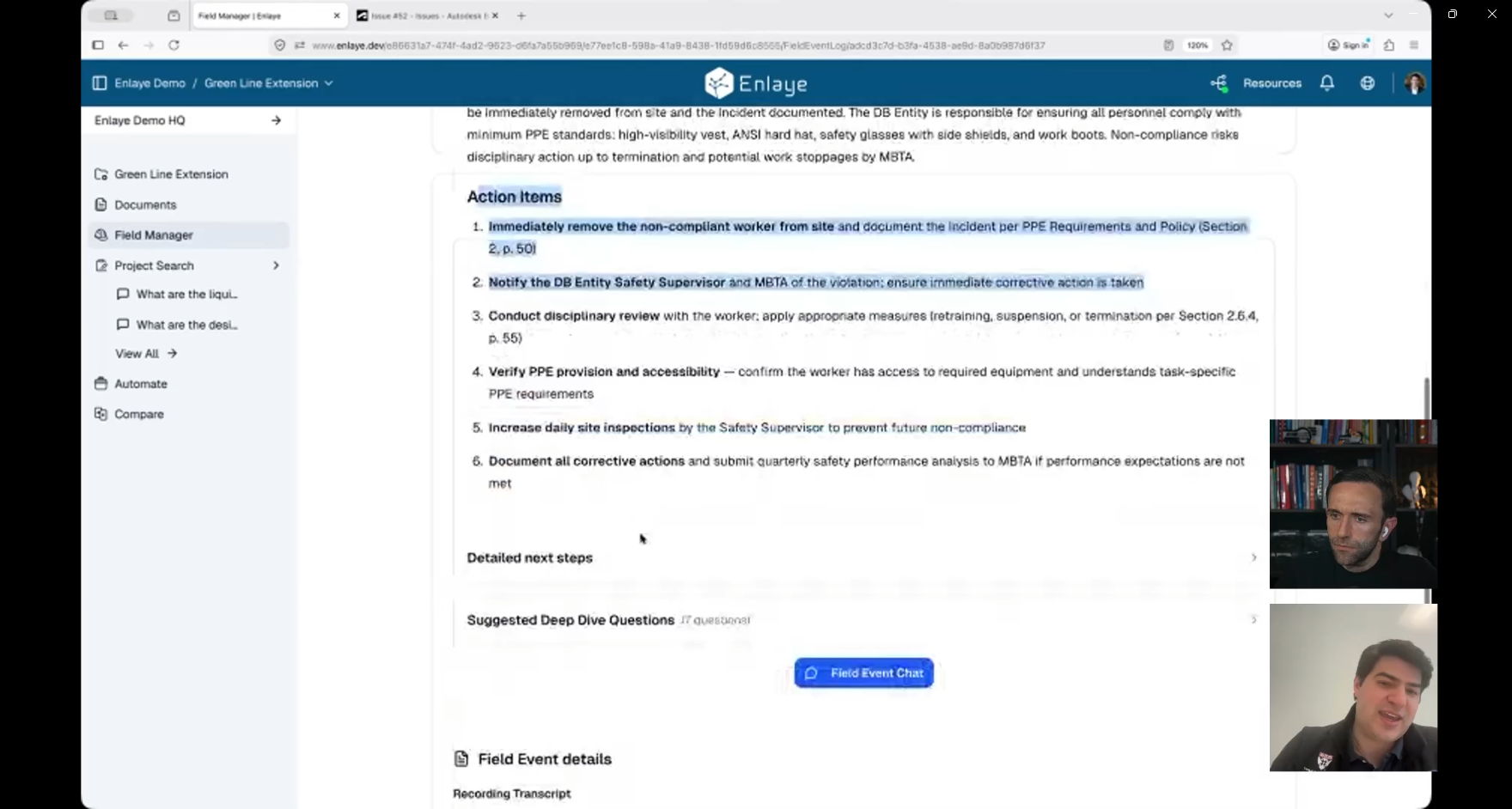
Connected to field tools (Autodesk Forma, Procore-style observations and issues), Enlaye automatically generates an analysis with recommended actions when an issue is logged, drawing on the project's risk profile and the company's procedures. Engineers get a leg up before they get back to the trailer.
General contractors across the size spectrum — from $5M school renovations to a $6B subway extension in Toronto. Enlaye's focus on commercial, contractual, and financial risk (rather than scope-specific risk) means the platform generalises across project types and sizes without retooling.

Active customers in the US, Canada, and France. No specific target market — Enlaye is geography-agnostic.
Less than a day to set up a single project. Heavier when ingesting historical archives — one customer onboarded 120 past projects, which required additional cybersecurity review. The default approach is to start small (one or two projects) and expand.

.avif)
.avif)


• Direct productivity / time savings. The benchmark example: a Montreal customer with a 100+ item risk register that previously took a five-person estimate and bidding team three weeks to produce manually. The Enlaye automation runs in 12 minutes. Total turnaround including human review: under a week — roughly two-thirds of the time saved
• Decision quality / scenario expansion. Less quantifiable but arguably more valuable — the ability to run 50 scenarios in the time you used to run 5. The framing: "risk is in the eye of the beholder," and the only way to get comfortable with a deal is benchmarking, comparing, and stress-testing scenarios. Enlaye unlocks that for GCs who can't justify the headcount of a dedicated data analytics team in a 3–5% margin business
$1.7 Million
Pre-Seed
Lead by Glasswing Ventures
Near-term — predictive and proactive. For customers who've reached critical mass of historical data on the platform, Enlaye is moving from "run the analysis you asked for" to "automatically run the scenarios you'd want to run anyway." When a new RFP lands, Enlaye triages it and pre-runs the relevant analyses based on the customer's historical patterns — so the user starts from an informed view rather than a blank page
In beta — automated lessons-learned generation. An agent that produces lessons-learned outputs from completed projects against company templates, extending Enlaye's coverage past handover
Defensibility. Three layers worth noting:
Pricing. Per-seat licensing, deliberately not per-project and not per-token. Multiple tiers; lower tiers carry rate limits on AI usage. There's a generous overall data ceiling per customer that no customer has hit. The reasoning Philippe gave is worth quoting in spirit: GCs need predictable cost they can put into an estimate, so Enlaye absorbs token-pricing variability internally rather than passing it through. Specific tier pricing not disclosed in the demo.
.avif)





.png)
