
Artificial Intelligence
Scoreboard AI eliminates the manual scope review that costs GCs change orders and competitive bids.
Scoareboard AI



Scoreboard AI automates scope buyout and procurement for commercial general contractors — turning thousands of pages of plans and specs into trade-by-trade scope inclusion packages that can be sent straight to subcontractors.
• After winning a project, GCs have roughly a month to convert the estimate into a firm price
• This means engaging ~30 subcontractors and soliciting 3–5 bids per package, with apples-to-apples comparison across them.
• The workflow is manual: PMs, procurement managers, or estimators work through drawings and specs in Bluebeam, mark them up, and rewrite scope into Word or Excel to become the scope exhibit in the subcontract.
• Most teams don't have time to do this properly.
• The shortcut — "you own Division 12, here are the drawings" — pushes the burden onto subs.
• Subs then either pad their numbers to cover assumptions (making them less competitive) or miss items tucked in the corner of a sheet.
• Missed items resurface later as change orders the GC has to eat.
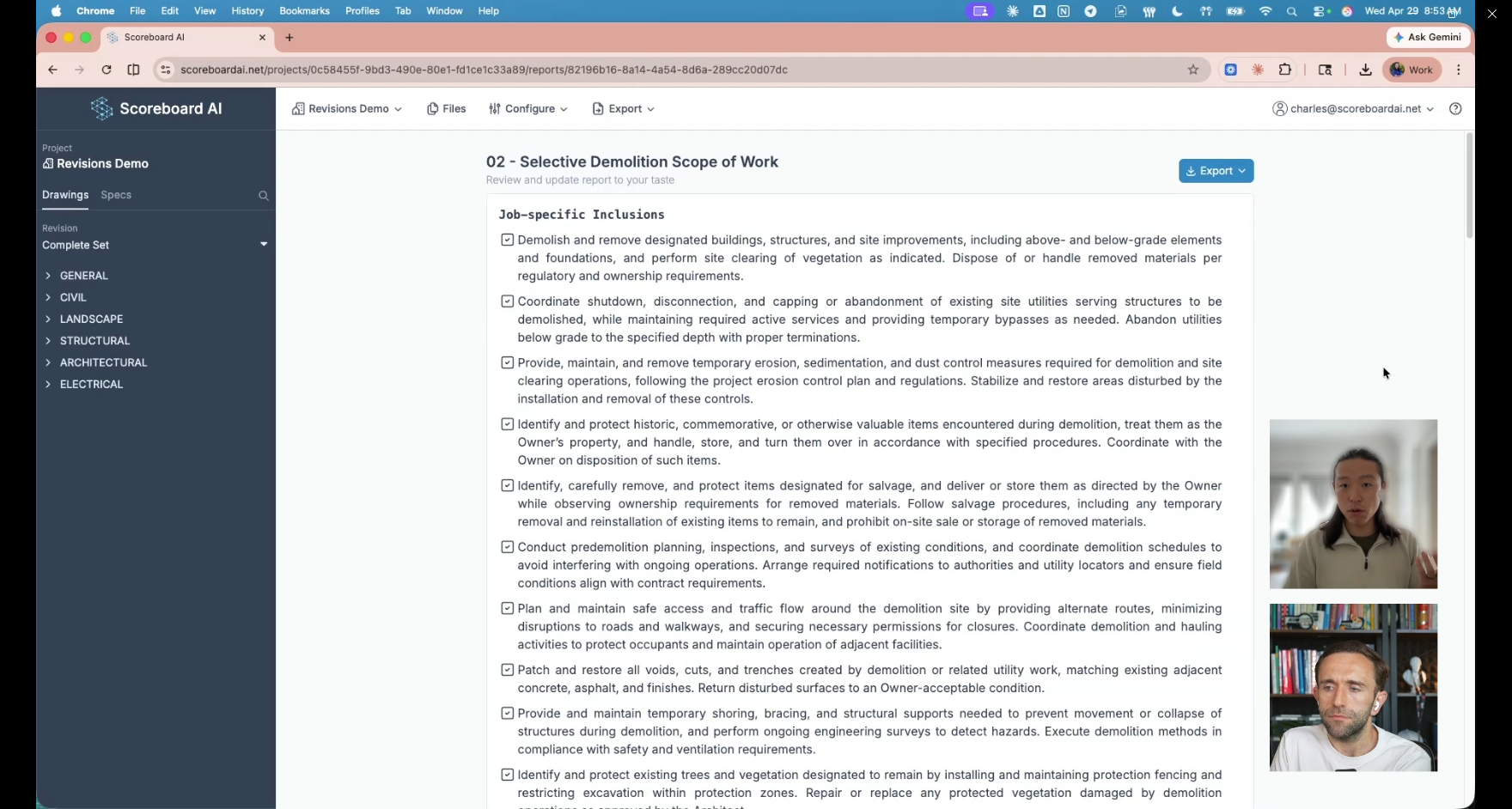
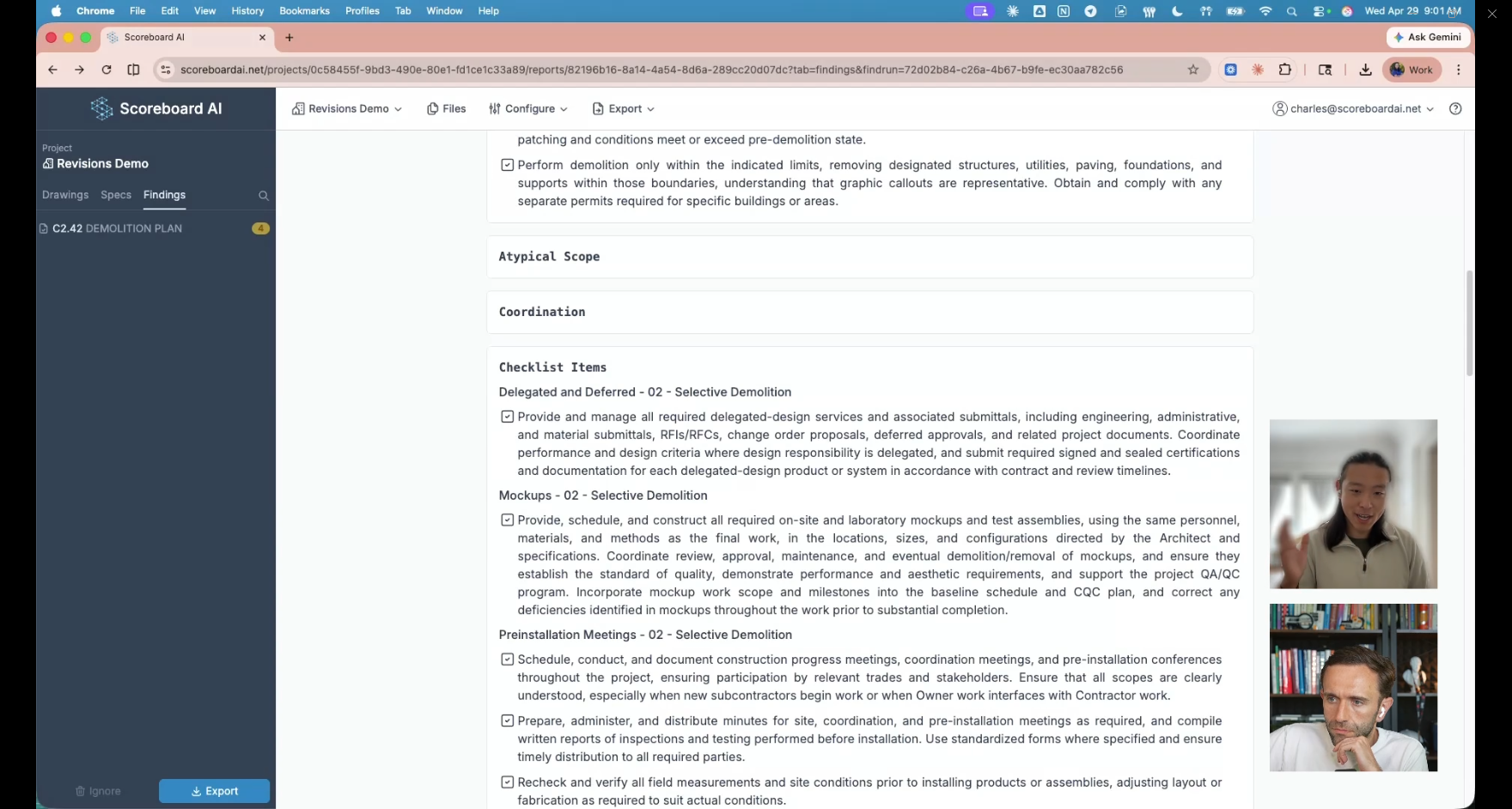
The platform parses every element across the plans, specs, and supporting documents (geotech reports, etc.), assigns each item to the responsible trade, and generates a scope inclusions report per bid package. Each line item links back to the source page so reviewers can verify provenance — a deliberate guardrail against hallucination. Output can be exported as PDF, CSV, or as a set of highlighted drawings showing only the sheets relevant to that trade.
Pre-construction, specifically the scope buyout phase between award and firm price. Adjacent value during design-build, where the revisions feature tracks whether OAC discussions actually made it into the issued set.
Setup. Drag-and-drop PDF upload. A 500-page set takes roughly 48 hours to process. Trades and a checklist of "gotchas" come configured by default but are fully customisable — users can submit their scope matrix and Scoreboard will configure bid packages to match (e.g. whether Division 26 and Division 27 are bought together or separately, whether rigid paving sits with concrete or exterior specialties).
Auto-generated per bid package, editable line by line, with each item linked back to its source page in the plans or specs.
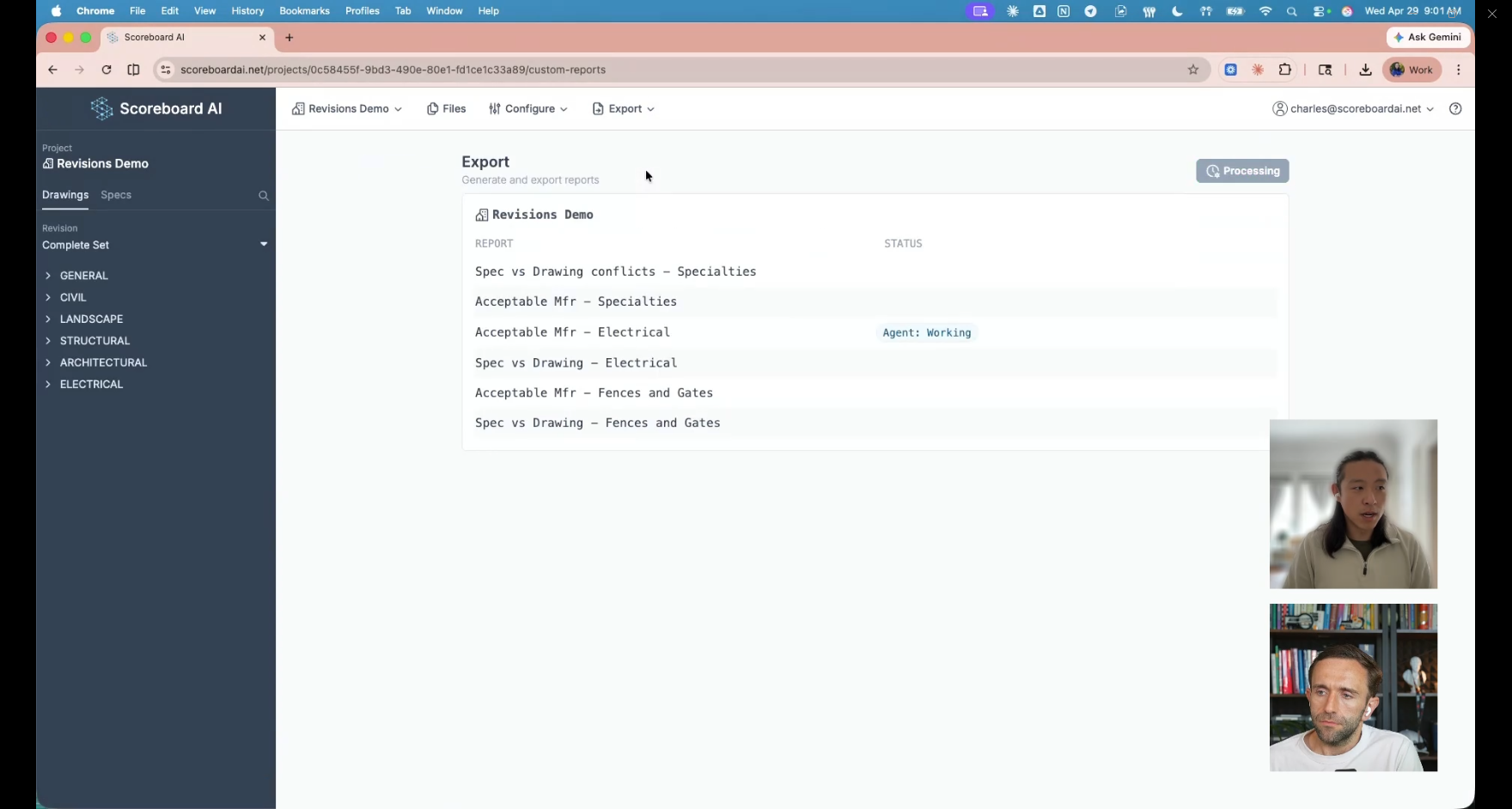
The system can output a filtered set showing only the sheets relevant to a given trade (e.g. for a signage sub, "here are the 12 pages out of 300 you need to look at")
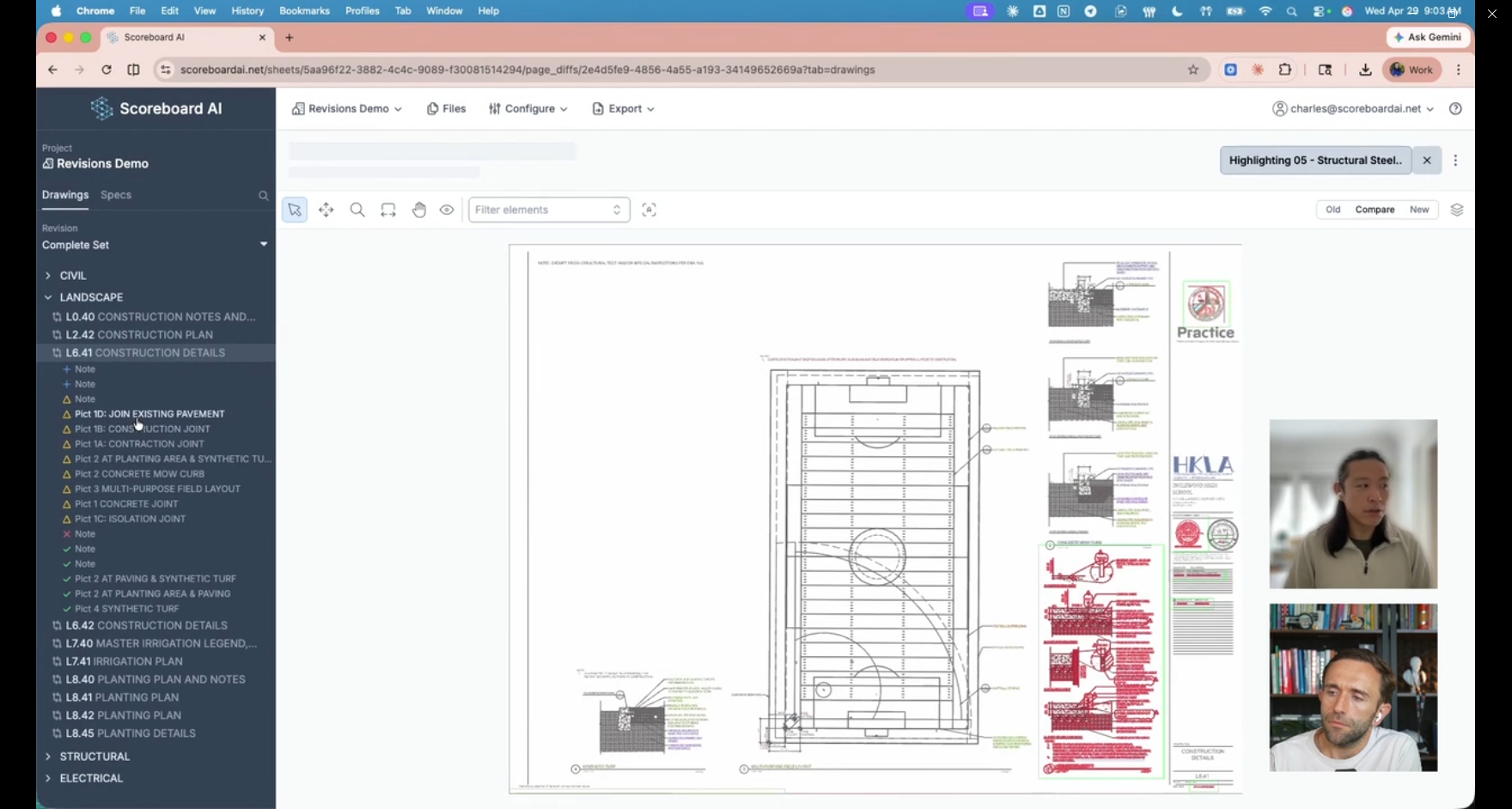
Start with powerful pre-built report templates—like acceptable manufacturers / basis of design or spec vs. drawing discrepancies—or create your own. Pull information from specific locations across your project documents and turn it into clear summaries, side-by-side comparisons, and easy-to-scan reports your team can act on.
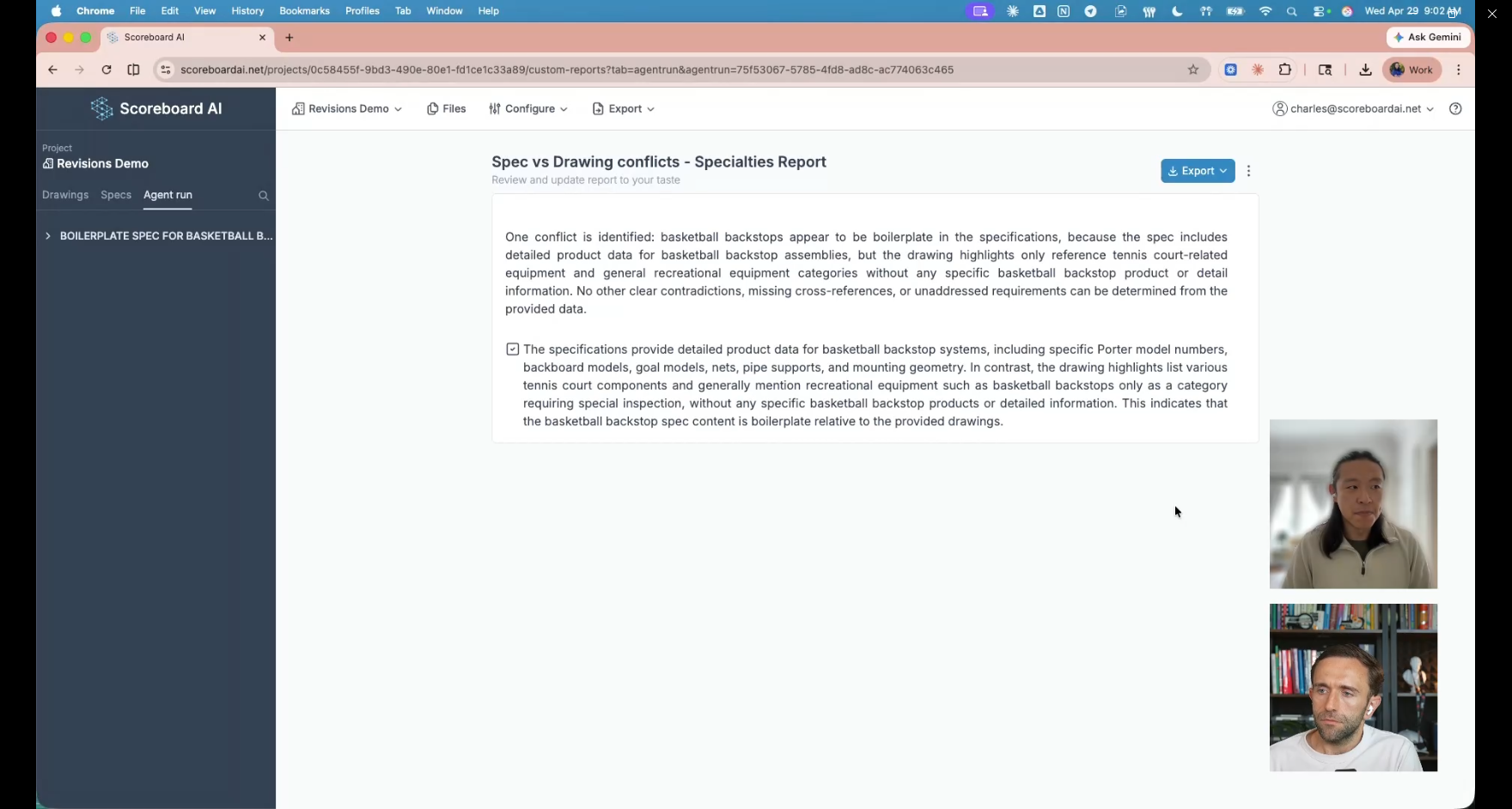
Flags inconsistencies between plans and specs (the demo showed specs calling for basketball backstops on a project where the drawings only had tennis courts).
A "never get burned by this again" list maintained at the company level rather than the individual PM level, so institutional memory doesn't walk out the door when staff turn over.
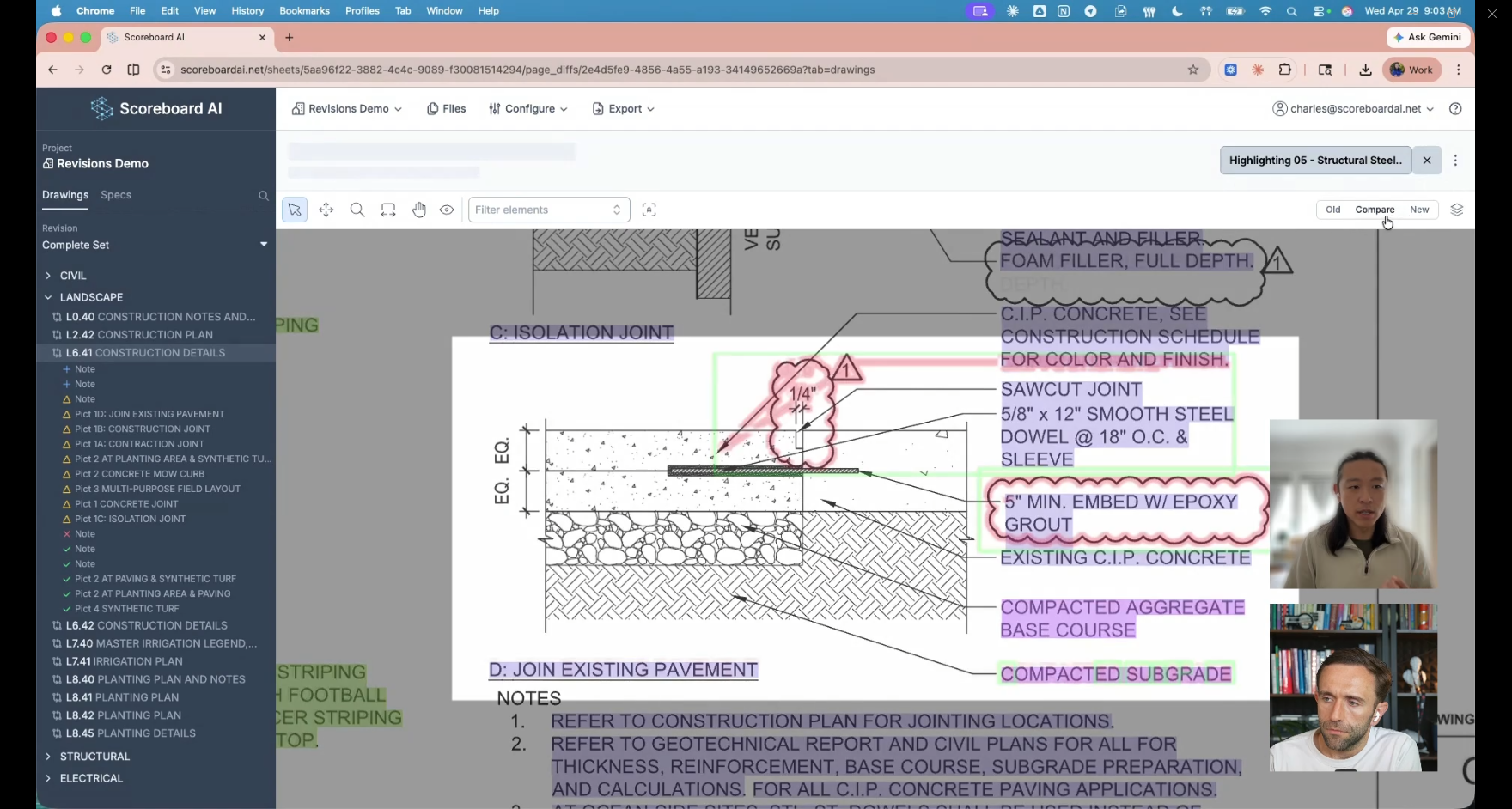
Upload bulletins, addenda, and revised sets; Scoreboard summarises additions, removals, and changes detail by detail.
Ideal user profile. The pre-con manager, project manager, or estimator (depending on company structure) who owns scope review and bid solicitation, juggling 30+ subs against a one-month clock.
Target customer. Commercial general contractors. Specialty subcontractors are a secondary user — they can use the tool to respond to bids faster.



US nationwide, customers from New York to Hawaii.
Customisation: Trade definitions are fully configurable. Standard inclusions upload (so the system can suppress generic items already covered by the GC's boilerplate and surface only job-specific scope) is on the near-term roadmap — within the next week or two per the demo.
Onboarding: One-week free trial. Drawings uploaded Monday, system configured by Wednesday, mid-week check-in Friday, wrap-up the following Tuesday. Fast by enterprise software standards.
.avif)
• Direct time savings, measured by what percentage of generated inclusions customers accept directly into their invitations to bid.
• Risk reduction, measured by errors and scope gaps caught before they become change orders.
Undisclosed
Undisclosed
Roadmap
Near-term (weeks):
Medium-term:
Long-term — and the more interesting bet. Today's product is text-heavy. The team is building visual understanding capabilities — symbols, drawing elements, diagrammatic content — using proprietary models trained from scratch. Charles notes that work he previously sized as 12–18 months out is now 1–2 months out, attributing this to the acceleration from training their own models rather than fine-tuning.
Defensibility. The model training trajectory is the stated moat — fine-tuning to fully proprietary purpose-built models, with the data flywheel from customer document ingestion. The construction-specific scope ontology and the verifiable source-of-truth linkage (which is harder than it looks to do reliably) are the operational moats.
Pricing. Usage-based, structured to reduce adoption friction:
.avif)





.png)
