


.png)
Jobotics AI
Product Overview
What Is It
Jobotics is an AI-powered answer and action engine built specifically for trade and specialty contractors. It aggregates data from a contractor's fragmented technology stack — project management platforms, ERP/accounting systems, safety tools, and CRM — into a single intelligence layer. Users can interrogate that data in plain English and trigger automated workflows, from generating risk dashboards and Excel reports to reviewing contracts and producing labour hour estimates. The platform's stated ambition is to become the AI-native operating system for all contractor workers.
The Problem It Solves
How it is currently done
Trade and specialty contractors — primarily mechanical, electrical and plumbing (MEP) firms — manage their businesses across a patchwork of disconnected systems: Procore or Autodesk Build for project management, Vista or similar ERPs for job costing, dedicated safety platforms, and CRM tools. Extracting meaningful insight across these systems is a manual, time-consuming exercise. Specific pain points include:
• Project managers jumping between tools to compile reports, spending hours on work that should take minutes.
• Executives and senior leadership lacking a real-time, consolidated view of project health — meaning risks surface too late.
• Field workers unable to get quick answers about material deliveries, installation specs, or schedules without escalating queries.
• Finance teams struggling to reconcile job costs across multiple platforms, with no single source of truth.
• Contract review delegated to external legal counsel due to volume and complexity, making it slow and expensive.
• Material take-offs and labour hour estimations done manually — page-by-page, copy-paste from PDFs — taking hours to days.
• Job closeout (packaging all project documentation for handoff) a laborious multi-hour process prone to error.
How Jobotics changes it
Jobotics sits as an AI orchestration layer above a contractor's existing tools — it does not replace them. By connecting to current systems via API or MCP integrations, it pulls data into a unified memory layer and exposes it through a conversational interface, automated workflows, and AI-generated outputs (dashboards, Excel sheets, slide decks, contract redlines). The value proposition is speed, consolidation, and proactive risk detection.
Area of Focus:
Specifically: trade/specialty contractors (MEP focus) operating in high-growth construction verticals — data centres, EV/battery manufacturing plants, and automotive factories. This is a sub-contractor play, not a general contractor platform.
Key Features
1. AI-Generated Risk Dashboards & Reports
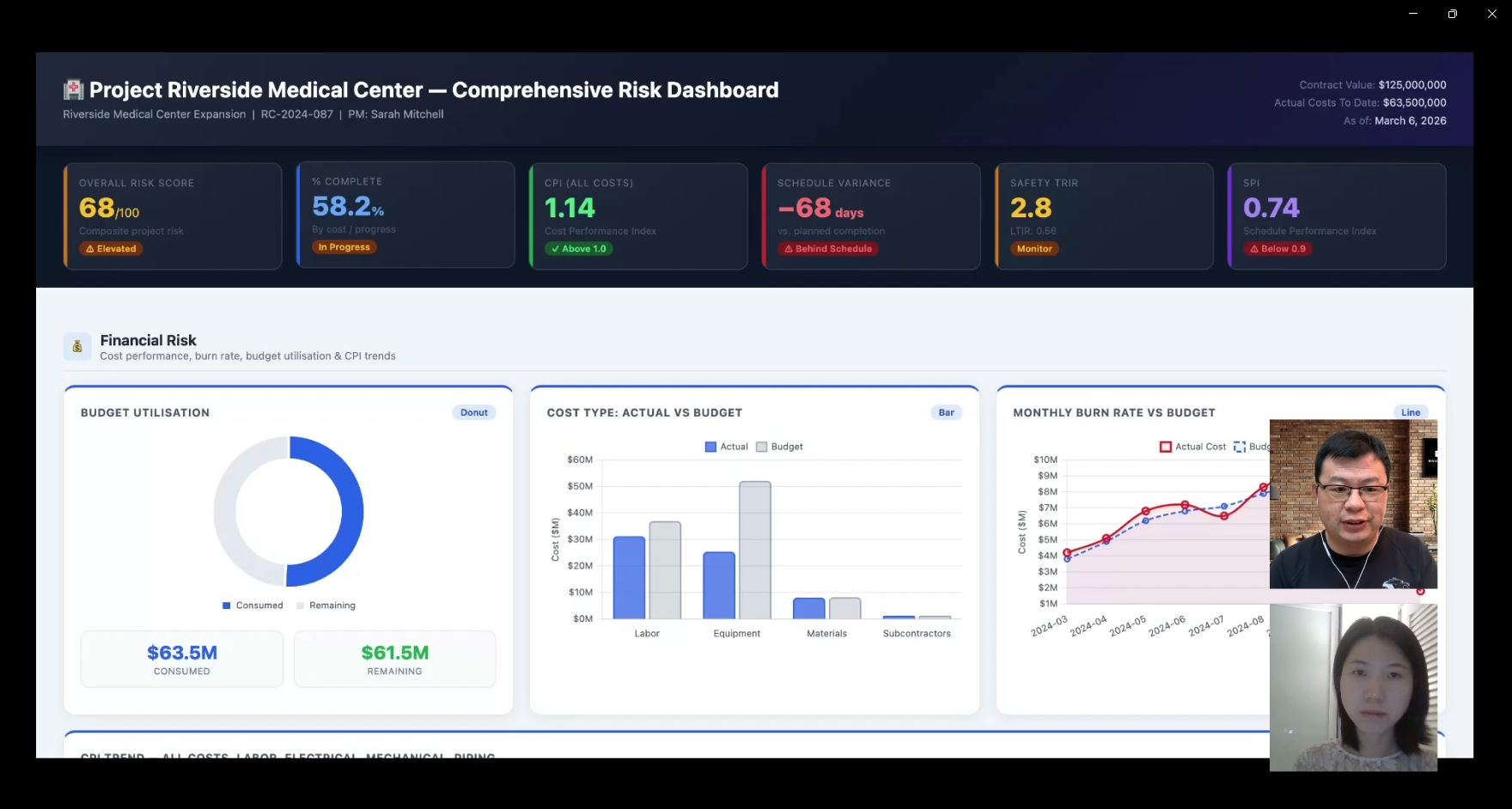
A single-screen project dashboard generated on the fly by AI, aggregating data from all connected systems. The demo showed a risk dashboard displaying overall risk score, cost performance index (CPI), schedule performance, and safety incident tracking — with correlation analysis across dimensions (e.g. safety events mapped against CPI trends). No human-built templates are used; the AI orchestrates the data and determines the layout.
Pain point solved: Leadership has no consolidated view of project health. Data is fragmented across tools and risks surface too late.
Output: Dashboard, Excel sheets, and PowerPoint slides — all generated in minutes from a single natural language prompt.
2. AI Contract Review
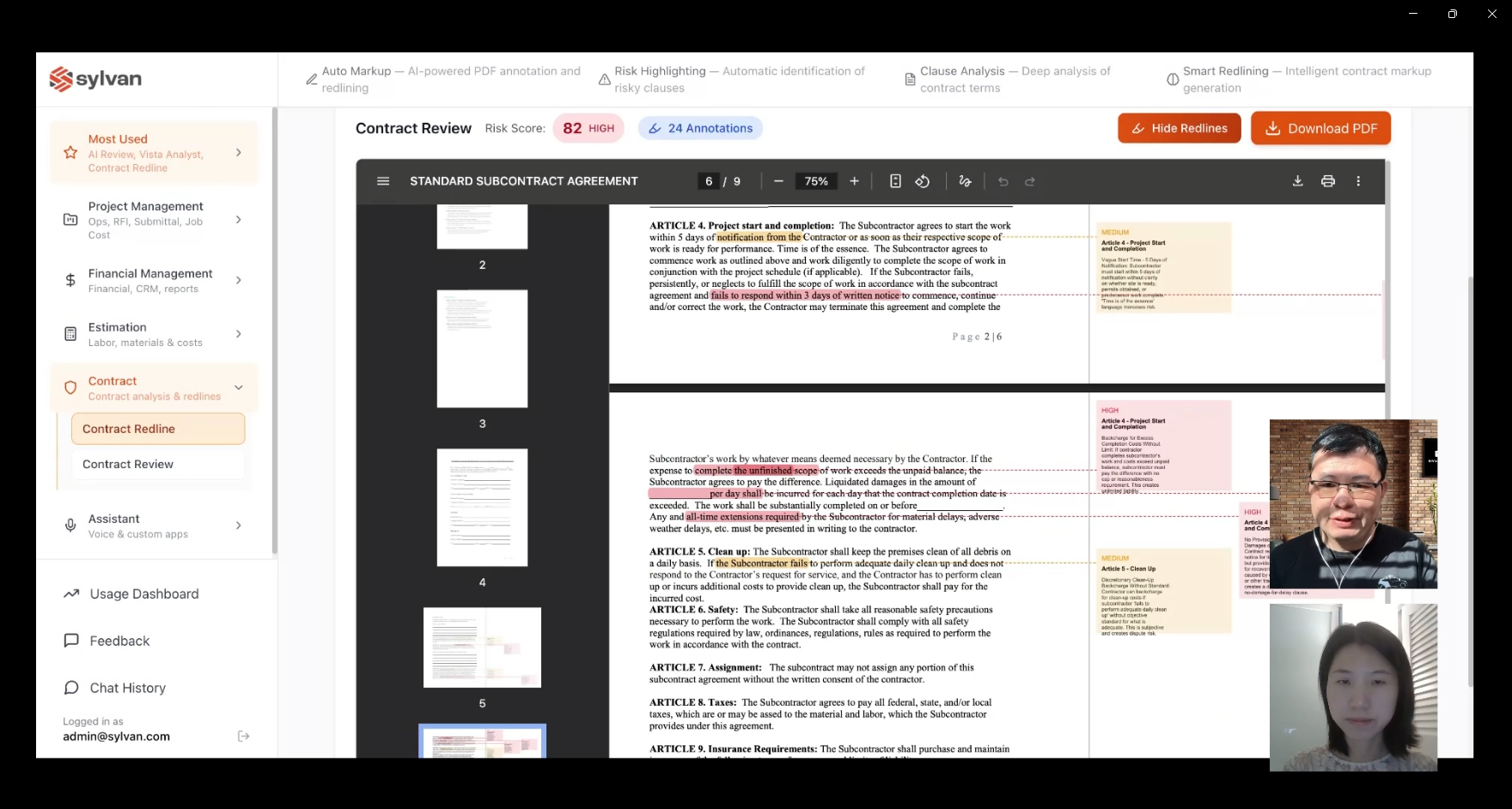
Users upload a contract PDF and receive a redlined document within minutes, with risk items flagged high/medium/low and mapped to specific clauses and paragraphs. The AI is fine-tuned on the client's own historical contracts, so it learns firm-specific preferences (e.g. payment terms, turnaround clauses) rather than applying generic legal logic.
Accuracy benchmarks (per demo): 88–90% recall against a qualified legal review. The AI also surfaces an additional ~30% of comments not identified by the legal team.
Pain point solved: Contractors pass contracts to external counsel — slow (up to one week turnaround) and expensive. Jobotics produces a first-pass redline in minutes, reducing legal spend to review of extracted key terms only.
3. Material Take-Off (BOM Generation)
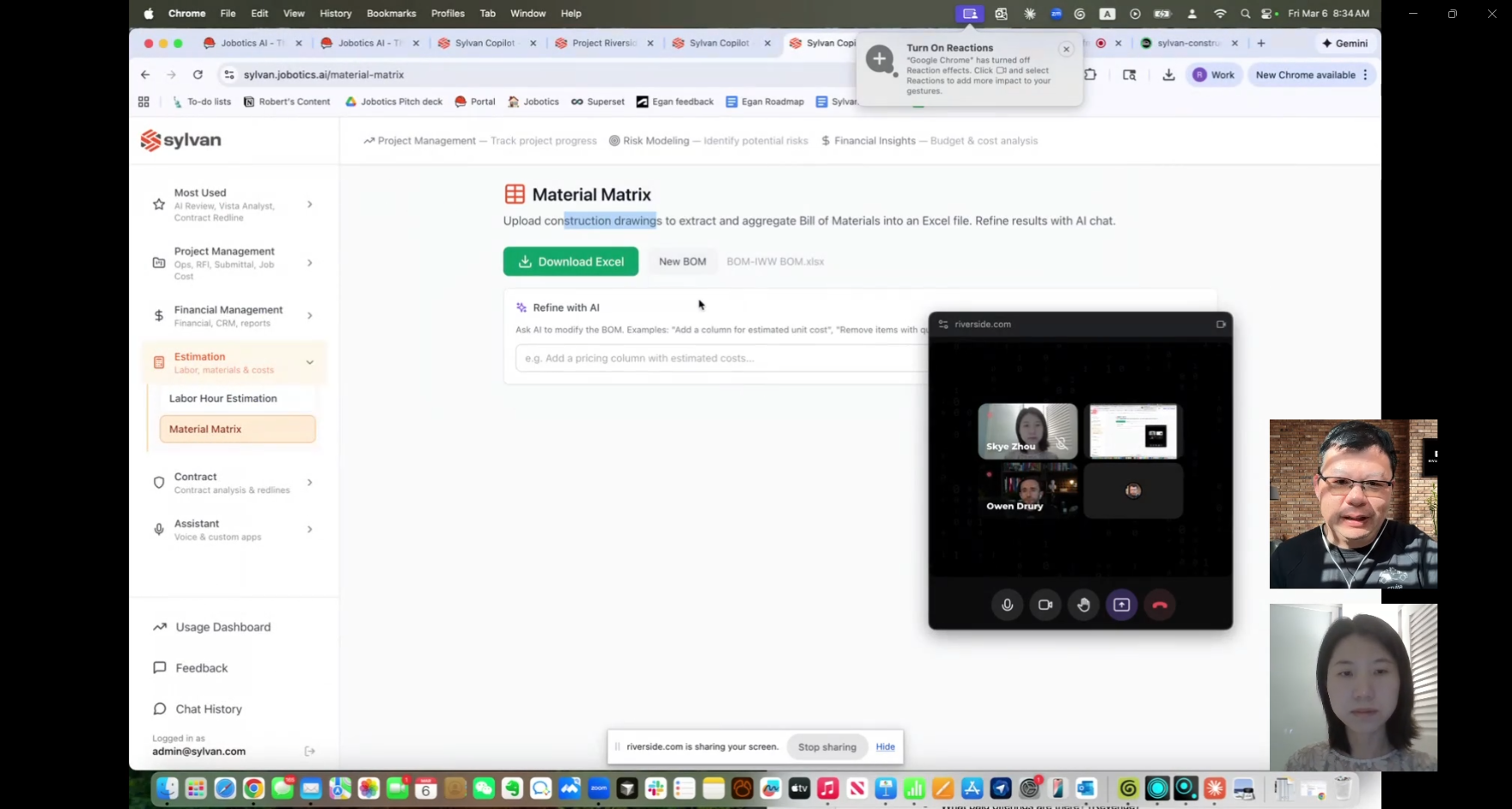
Users upload 2D drawings, specifications, or bid documents (PDF, DWG, BIM model). The AI extracts all materials and generates a structured Bill of Materials in Excel, with quantities, descriptions, source references, and a summary tab. The system cites where each match was found in the MCAA database, providing an audit trail for validation.
Accuracy: 95% hit rate on material matching per demo benchmarks. Human-in-the-loop validation is built in.
Pain point solved: Manual take-offs require page-by-page review and error-prone copy-paste from PDFs, taking hours or days. Jobotics reduces this to minutes for the initial draft.
4. Labour Hour Estimation
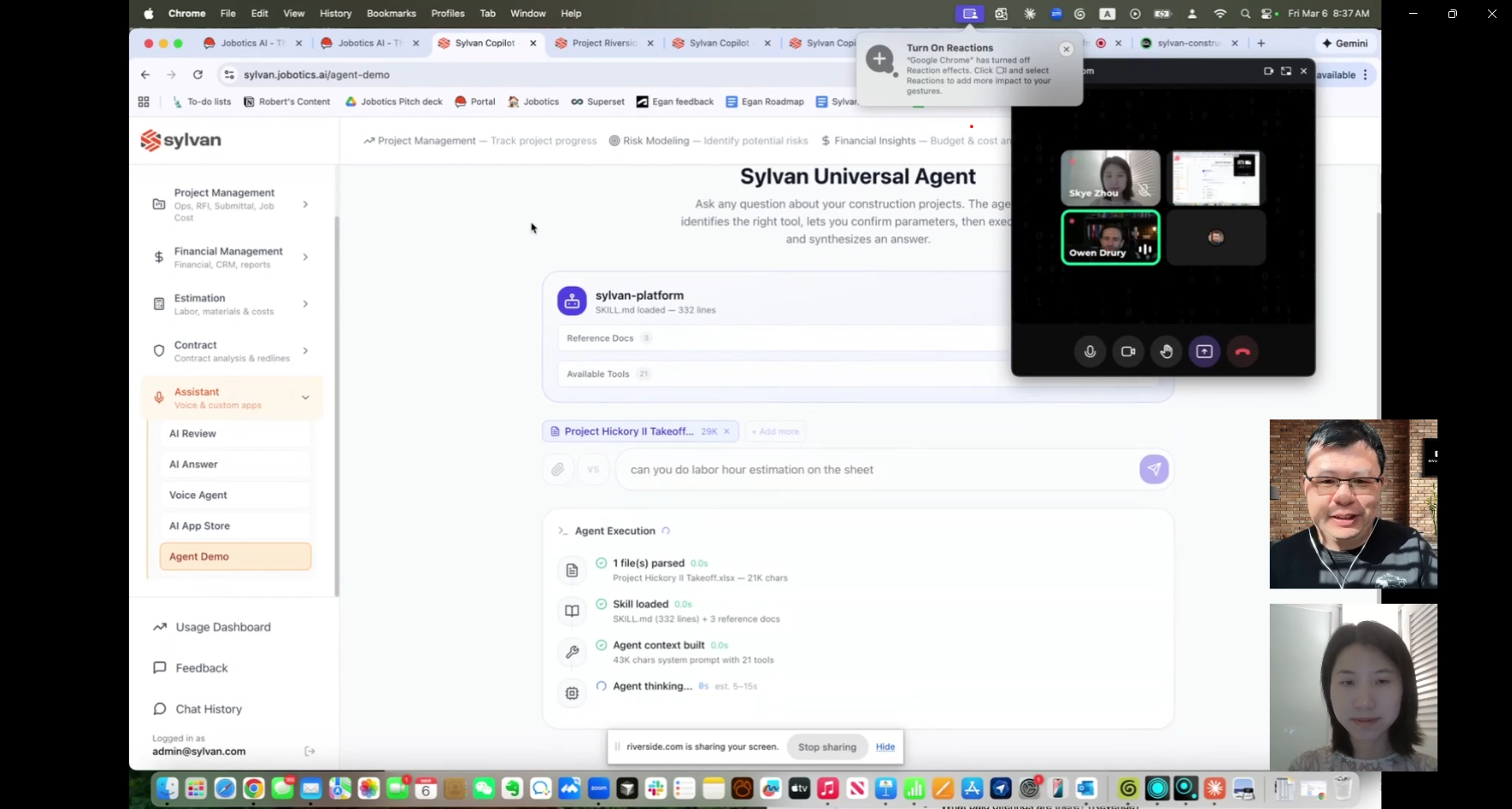
Given a material list or specification, the AI generates a labour hour estimate by referencing MCAA and other trade labour databases. Output is a multi-tab Excel workbook showing estimated hours per section, matched against the relevant database entry for each line item.
Pain point solved: Labour estimation for MEP trades is highly specialised and typically done manually by experienced estimators. Automating the first-pass significantly accelerates the pre-bid workflow.
Used By
Target Customers
Mid-to-large trade and specialty contractors, specifically MEP firms.
Minimum viable size: ~$20–50M annual revenue.
Current sweet spot: $350M–$700M+ revenue, 100–300+ employees, operating across multiple states and/or divisions.
Trusted by Leading Organisations
Andy J. Egan Co.
Revenue:
$240 Million
Employees
200+
Jobotics AI automates critical construction workflows—job close-outs (98% faster, 4 hrs → 3 mins), contract reviews (93% faster, 1 week → 30 mins), and material matrix generation (85–95% faster, 1 week → 2–4 hrs). It also enables 40–70% faster information search, eliminates manual drawing comparisons, and helps teams scale to 2× productivity without increasing headcount.

Sylvan
Revenue:
$700 Million
Employees
200+
With Jobotics AI, teams achieve 90% faster decisions, save 5+ hrs/week per PM, 16+ hrs/month in reporting, unlock $40M revenue gains, $3M+ productivity gains, and resolve RFIs 30% faster.
Operating Locations
US-focused, with at least one client operating in Canada and Mexico.
Implementation & Onboarding
Important Considerations
Forward Deploy Engineer (FDE) model, deployment methodology:
• Step 1 — Consultation: Assess client's current tools, data, and workflows.
• Step 2 — On-site FDE Assessment (3 days): Embed with the client team on-site; map use cases, data sources, and integration requirements. Begin integration in situ.
• Step 3 — Product Build & Deployment: Complete integration and customisation, typically within a few additional weeks.
• Step 4 — Ongoing iteration.
Claimed implementation timeline: Weeks, not months. Compared favourably in the demo against Procore/Autodesk implementations which typically take 9–12 months end-to-end.
Security & Privacy
.avif)
Integrations

ROI & Value
Time saving
Before/after comparison per workflow. Examples given: job closeout reduced from ~4 hours to 3 minutes; contract first draft from days to minutes; material take-off from hours/days to minutes.
Cost saving
Legal spend reduction (contract review); reduced administrative overhead.
Revenue recovery/margin improvement
The headline example — a client recovered $40M in accounts receivable after AI surfaced $60M in overdue balances fragmented across projects that leadership had no visibility of.


Funding
Total Raised
Undisclosed
Investors
E3Tech
About the Company
Product Demo
Alternative Solutions
Comming soon
Trusted by Leading Construction Companies
Andy J. Egan Co.
Revenue:
$240 Million
Employees:
200+
Sylvan
Revenue:
$700 Million
Employees:
200+
Join Industry Leaders


.avif)
Thank you! Your submission has been received!
Oops! Something went wrong while submitting the form.


